I’d been aware of the Ann Arbor film festival since I moved here a few years ago, but I hadn’t known until recently that it’s both a qualifying festival for the Oscars, and North America’s oldest experimental film festival! Running since 1963, it’s a low-key festival that features a wide range of genres and styles over a few days of programming.1 Being a long-time fan of Wavelengths (the experimental film program that takes placea as part of the Toronto International Film Festival), I was intrigued. Most years it has felt like the Ann Arbor festival has happened at an especially busy time, but somehow this year things felt much more under control, so I somewhat spontaneously decided to buy the all access pass, and try to see as much as I could.
Although there was a huge amount that I did not see, I feel like I got a decent sampling of what the program had to offer. Almost every screening I saw was a collection of shorts (each roughly between 1 and 50 minutes), which was actually perfect, as it meant there was a huge amount of variety, and basically nothing went on for too long. Many people asked me later what makes something an experimental film, and my standard answer is that it is film that eschews standard use of narrative and/or character, often in favor of exploring more formal characteristics of the medium (whether that be film, digital, or something else). There are obviously moreor less extreme versions of that, but overall that feels like a reasonably accurate characterization to me.
Among those showing at the festival, the films ran the gamut, from slice-of-life documentary, to found footage, to mixed media, to static photography attending to the beauty of the world, to various forms of animation, including both AI-generated video and more conventional algorithmically generated imagery. Many of these films did of course involve varying degrees of character and/or narrative (especially implicitly), but overall the emphasis was much more on experimentation, to reflections on process, and to meanings which lay beyond the frame, compared to mainstream film.
The films that felt the most familiar and approachable generally operated in a documentary mode. Several of these were classic portraits in the vein of early Errol Morris, often focusing on an eccentric but charismatic figure, or a particular scene. One, called Motorcycle Moment, used footage shot by Les Blank (of Burden of Dreams fame) for a documentary that he never completed; the result, edited by Ben Abrams is a quick six-minute portrait of motorcycle enthusiasts circa 1964, dripping with heartland Americana. Another, called American Alternative focused on Kurt Heyl, (apparently an underappreciated figure in the Chicago film scene of the 1960s), and was entirely composed of footage from Heyl’s films, on top of which were layered audio interviews that filmmaker Josh B. Mabe recorded with Heyl.
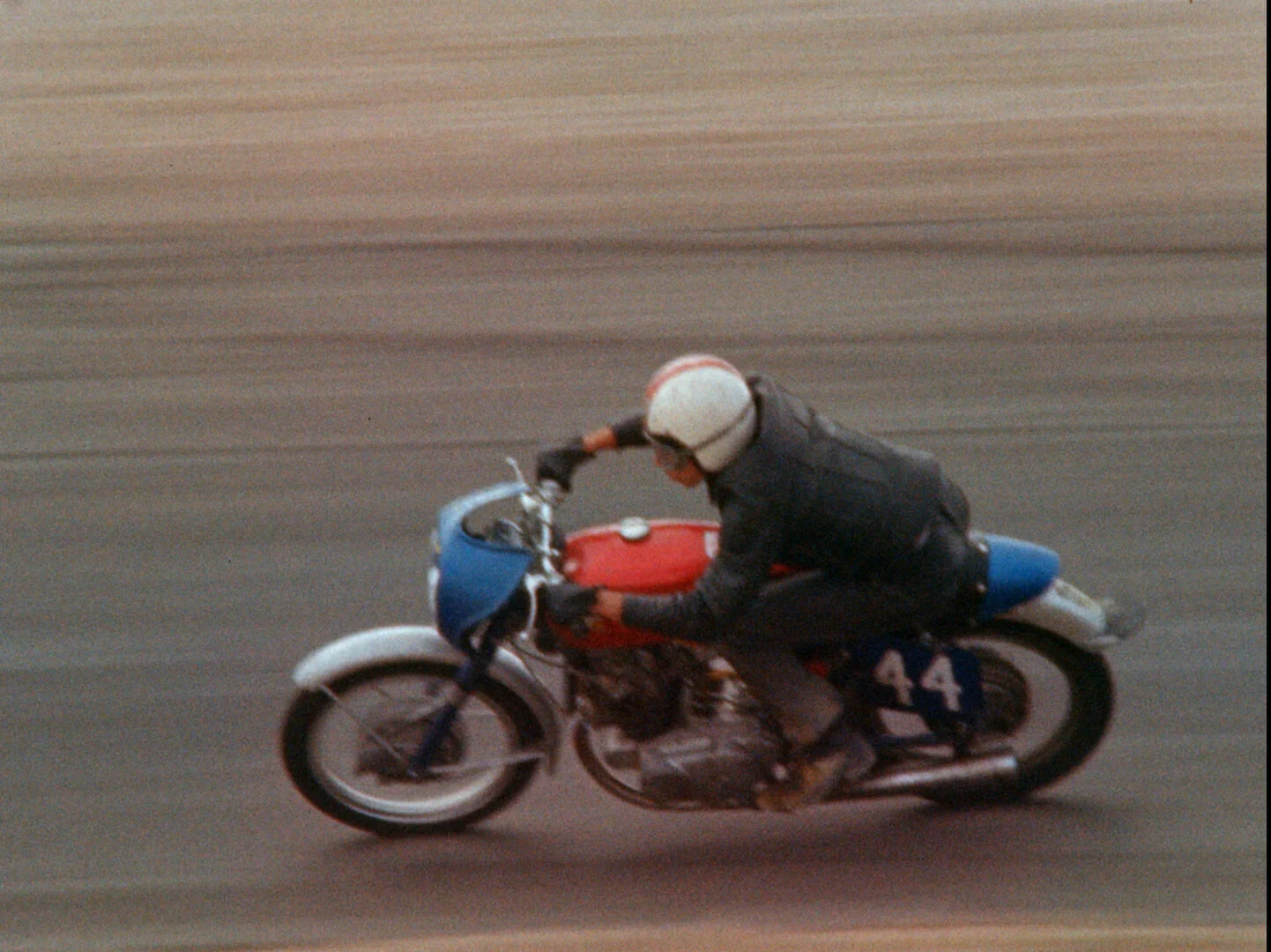
Official image for Motorcycle Moment
A third example was perhaps the most poignant, and a good example of the form. It focused on Leonard Knight, the man behind the Sacred Mountain in Northern California. At least as told in the short, Leonard was something of an itinerant who eventually found god, settled into northern California, and came to start painting a small mountain in the desert, which eventually became a kind of Christian tourist shrine. In the vein of so many obsessives, Knight seems content, albeit slightly unhinged, fully aware that he is living differently than others, and more or less proud of that fact, but also living what is hard not to see as a kind of sad or lonely life. But of course a lack of close associates is not synonymous with loneliness, and his passionate dedication to an artistic project is something that is hard not to admire. Indeed, it’s easy to see Leonard as a more extreme manifestation of the tendencies present in so many of the other works that showed at the festival. At least one person mentioned taking six months to produce a three-minute short, for example.2
Understandably, as with almost everything else these days, thoughts and feelings about generative AI were threaded throughout the festival. Practically speaking, the majority of films being shown were about as remote from AI as could be. To take a very simple example, a three-and-a-half minute short called That Bolex Thing is about (if it is indeed about anything) a familiar visual effect that results from the mechanical design of the hand-cranked Bolex film camera (introduced in the 1920s), which results in a colourful over-exposure of the chemical film. And yet, the concept and implications of AI have grown broad enough to potentially touch everything. For films that focused on creating unique imagery, such as A Light Unseen—which mostly consisted of static shots of light passing through spider webs—it’s hard not to think about how easily AI could or could not create variations on that, if given access to the right training data.3 Others, however engaged with AI much more directly.
Of those that I saw which did so, the first was AI Movie, by Jen Proctor. I was especially grateful she was present for the Q&A afterward, as some additional context was extremely helpful in this case. Watching her film, which interspersed titles with generated imagery, it seemed to be something like a reasonably well done use of an early AI-based video generation system, complete with the artifacts that come with it. The scenes (such as they were), seemed to proceed through certain themes, such as extreme sports, and military conflict. In each case, the kind of dream-like logic that governed much of the earlier video AI work reigned, such as vehicles moving through a space, but not in a way that aligned with coherent physics. Oddities, like a “The End” intertitle coming right at the beginning, seemed easily explainable by the lack of coherence in AI-generated output. During the Q&A, however, Proctor explained that her film was actually a remake of a remake. Starting from “A Movie”, a 1958 short by Bruce Conner, which is famous as an early example of an experimental film using found footage, Proctor had previously remade a version of it using material sourced from YouTube. This new work was her update of that remake to contemporary times, done in part because everything related to AI is moving so fast, that the interesting seams may soon no longer be so visible. Looking back at the original, things make infinitely more sense, especially the parts that are clearly intended (by Conner) to not make sense.
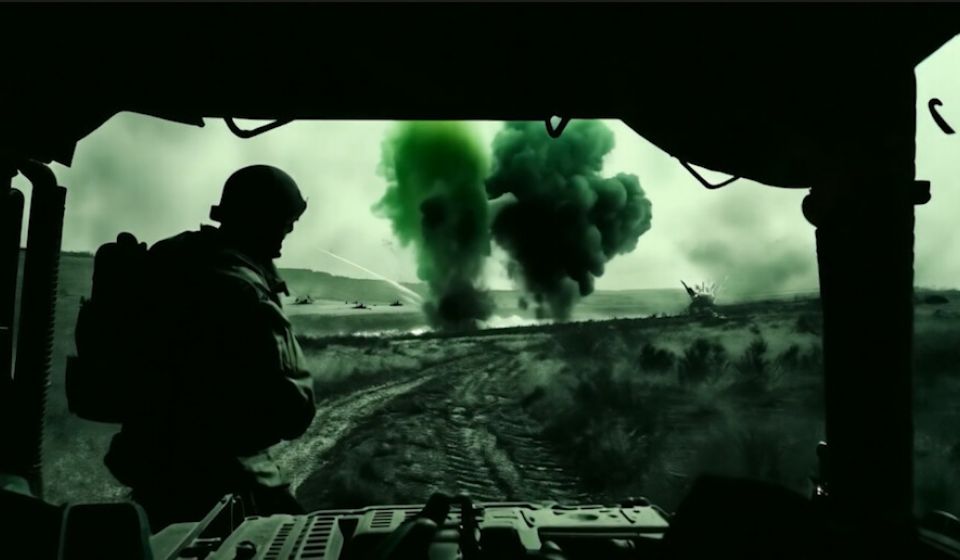
Official image for AI Movie
Other films explored variations on that same theme, but none were quite as deeply rooted in film history, so far as I could tell. One called Algorithmic Nudes Grapple with Entropy similarly used AI, but leaned into highly surrealist imagery, constantly manifesting some kind of semblance of nude bodies, but never quite resolving themselves into coherence, all against a background that inevitably conjured Dali or Magritte. The creator, David Witzling, explained in the Q&A after that this was a highly laborious process, based on curating and pairing images together, and then using a kind of archaic diffusion model to generate the footage. Each modification, however, required regenerating the entire film, a process which took 15 hours, meaning that only one or two edits could be made per day.
Watching these, I couldn’t help but think of the comment that has been made, that no interesting art work has yet been made with generative AI, even though artists are normally exceptionally good at adopting and exploiting new technologies, and reworking them for interesting artistic purposes. Watching many of these films, I felt like they were to some extent counterproof, showing that filmmakers in particular are making interesting use of these tools. At the same time, the degree to which aspects of this aesthetic were similar across these films does perhaps reveal some kind of limitation with respect to steering or control. Is it fair to expect something more unique from each filmmaker? It’s hard to evaluate how much overlap we are seeing, compared to what was produced in the wake of something like photography, but there’s something about these works that leaves one with the feeling of AI doing a lot of the work, with the main thing that stands out being the stylistic quirks of earlier video generation systems.
One last film that dealt with generative AI directly apparently made no actual use of it. The film called Climate Control by Sarah Lasley was an extremely clever take on how to think about responsibility for images in the face of AI. Starting off like a much more conventional documentary about the destruction of a German town for the purpose of fossil fuel extraction, the film inexplicably veered into a meet cute-style romance, and other extremely tropey content somewhere between a Hallmark movie and a Starbucks ad. It gradually became clear that this was actually a story about a documentary filmmaker who was working with AI, trying to be true to her vision, and yet also trying to make her work more popular at the same time, only to be taken in by her own use of the artifice. It was revealed during the Q&A that this had been made in collaboration with Lasley’s film students at Cal Poly Humboldt, and was therefore an example of the kind of community-based film making that is also representative of a different thread of experimental film. In many cases, as with this film, the mode of production might matter as much as the final product.
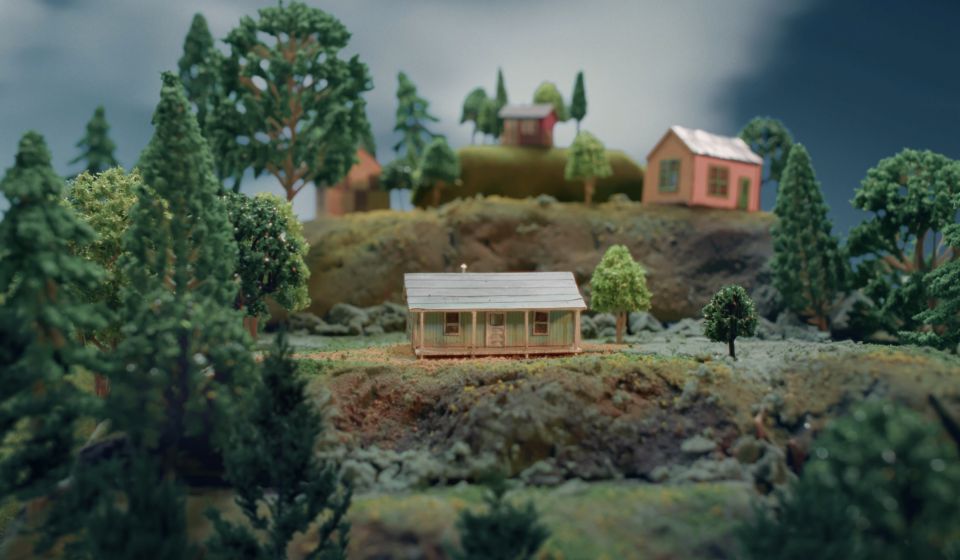
Official image for Climate Control
A final genre worth commenting on is the use of found footage or archival imagery. Panic in Nowhere, for example, used footage taken from YouTube of dust storms in the Southwestern US as the basis for a kind of found-footage disaster movie, eventually veering more into related disaster-movie tropes, like people getting lost in the desert. Another brief beautiful film called [sun]film used hundreds of archival images of depictions of the sun in a kind of visual montage showing an orb gradually moving across the screen as it grew and shrank. By far the most hilarious film that I saw at the festival was Juggernaut, which used footage made by influencers (mostly men), highlighting the rhetorical sameness and narcissism of so much of that material. Most of the film used a 3x3 grid of heads, bodies, and legs (much like the children’s game of the same name), with revealing echoes across what was said by the heads (e.g., about making money, buying a home, etc.), often punctuated by a brief moment of dancing by one of the pairs of legs.
Finally, one of the most striking and alluring films was simply (as if anything is simple) two archival reels intercut together, two frames at a time. Crystal Palace combined two sources: one was a few shots inside the now-defunct Crystal Palace roller derby arena in Memphis Tennessee. The other was an old scientific film of crystals growing. According to the director, Linda Izcali Scobie, an archivist delivered these two reels to her, and through experimentation, she ended up intercutting them (by hand, no less!). Although the number of frames is apparently consistent throughout, something about the imagery gave a powerful sense of a constantly shifting rhythm of intercutting. The whole thing was amazingly hypnotic and disorienting.
There is a vast amount that I didn’t see, including Out Night, and the longer retrospectives devoted to particular people and institutions.4 Nevertheless, it was a delightful festival, somehow both intimate and expansive. I’m sure I saw more individual films in one week than I had in the preceding year (many of them quite short of course), and there was a wonderful sense of community that developed, with many of the same people appearing at many screenings, including many of the filmmakers themselves. There is much more I could talk about here, but this is too long already, and schedule permitting, I will absolutely be in attendance next year!
As someone joked to me before one showing, the key thing that distinguishes the Ann Arbor Film Festival from other festivals is that there is absolutely no chance of a film being picked up for distribution (lol). There’s basically no money involved, so people are only there for the art and enjoyment. ↩︎
My own limited experience with filmmaking was closer to 48 hours of work for a one-minute film, but that was obviously far less professional. ↩︎
One of the more poignant parts about the festival was the feeling that I’ll likely never have the chance to see the vast majority of these works again. ↩︎
The full program is still available online, and the list of award winners is available here. ↩︎